
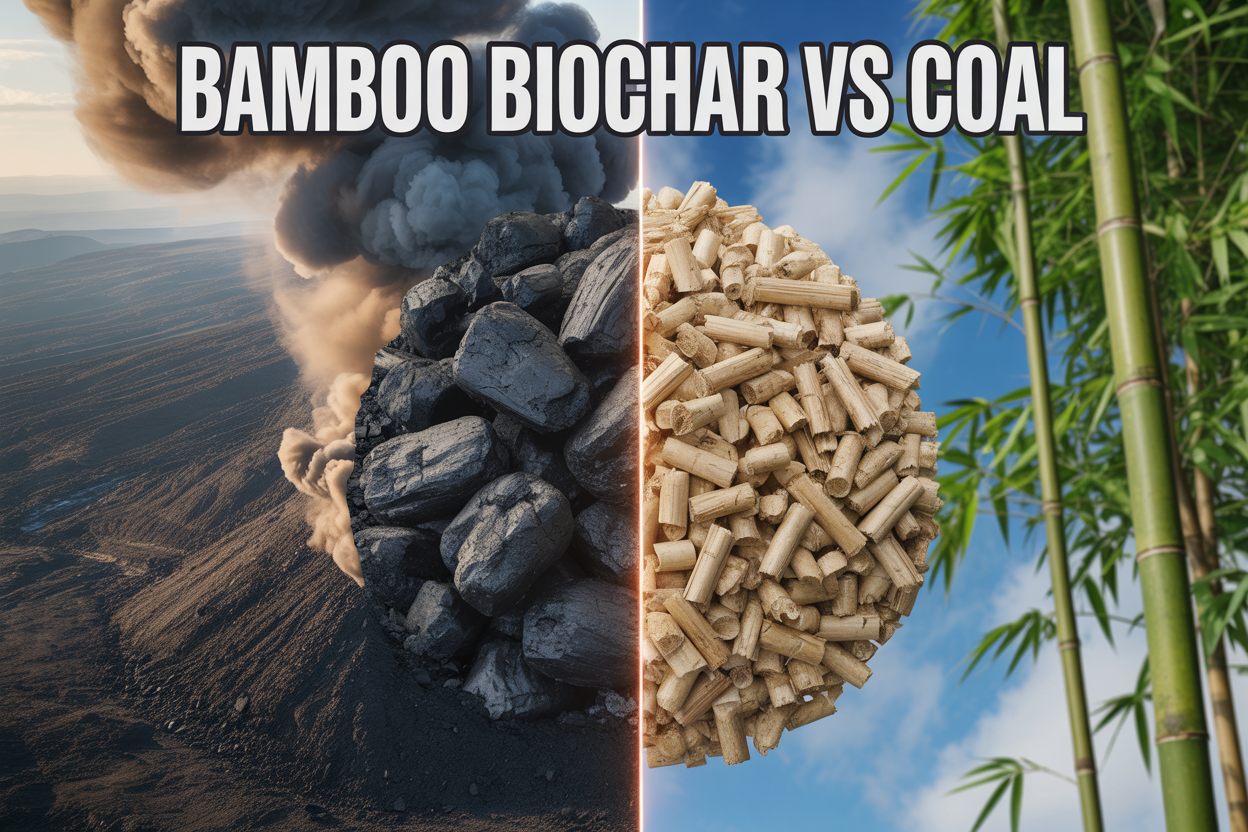
Bamboo Biochar vs Coal: The Environmental Showdown
The energy world is changing fast, and two materials couldn’t be more different in their environmental impact. Bamboo biochar represents a clean, sustainable alternative that’s capturing attention from environmentalists, energy companies, and policymakers alike. Meanwhile, coal continues to dominate global energy production despite its well-documented environmental costs.
This comparison is for anyone curious about clean energy alternatives to coal – whether you’re an environmental advocate, business owner exploring sustainable options, or simply someone who wants to understand how these materials stack up against each other.
We’ll break down the real carbon footprint comparison biochar coal by examining hard data and production methods. You’ll also discover the practical bamboo biochar applications that are already making a difference in industries from agriculture to energy storage. Finally, we’ll explore what the science tells us about each material’s long-term environmental impact and why this matters for our planet’s future.
The choice between these materials isn’t just about energy – it’s about the kind of world we’re building for future generations.
Understanding Bamboo Biochar’s Revolutionary Properties
Rapid Carbon Sequestration Capabilities
Bamboo biochar stands out as a carbon sequestration powerhouse, trapping atmospheric CO2 at rates that make other materials look sluggish. When bamboo undergoes pyrolysis, it locks away roughly 30-40% of the original carbon content in a stable form that can persist in soil for centuries. This means each ton of bamboo biochar removes approximately 2.6 tons of CO2 from the atmosphere – a game-changing ratio for climate action.
The secret lies in bamboo’s natural growth cycle. Unlike trees that take decades to mature, bamboo reaches full size in just 3-5 years while absorbing massive amounts of carbon during photosynthesis. When converted to biochar, this captured carbon becomes stable and won’t easily return to the atmosphere, creating a permanent carbon sink that outperforms most biochar environmental benefits.
Research shows that bamboo biochar can maintain its carbon sequestration potential for 100-1000 years when properly applied to soil, making it a long-term solution rather than a temporary fix. This stability factor gives bamboo biochar a significant edge in carbon footprint comparison biochar coal scenarios.
Renewable Resource Regeneration Benefits
The renewable nature of bamboo transforms the entire biochar production equation. After harvesting, bamboo regrows from its existing root system without replanting, reaching maturity again in just a few short years. This regenerative cycle creates a sustainable loop that coal simply cannot match.
Bamboo produces up to 35% more oxygen than equivalent tree stands and grows in diverse climates without depleting soil nutrients. Many bamboo species actually improve soil quality through their extensive root networks, preventing erosion while building organic matter. This natural soil enhancement pairs perfectly with biochar’s soil improvement properties.
The rapid regeneration cycle means bamboo can be harvested multiple times from the same plot without environmental degradation. Some bamboo varieties can be cut annually, creating a reliable feedstock supply for sustainable biochar production operations. This consistent availability eliminates the boom-and-bust cycles associated with other biomass sources.
Superior Porosity for Enhanced Performance
Bamboo biochar’s microscopic structure resembles a complex highway system with interconnected pores that dramatically increase surface area. This porosity typically ranges from 300-500 m²/g, creating abundant space for nutrient retention, water storage, and microbial habitat in soil applications.
The pore structure includes both micropores (less than 2 nanometers) and mesopores (2-50 nanometers), optimizing the material for different functions. Micropores excel at gas adsorption and contaminant removal, while mesopores facilitate water and nutrient movement. This dual-pore system makes bamboo biochar incredibly versatile across various applications.
When applied to soil, this porosity translates to improved water retention rates of 15-30% and enhanced nutrient holding capacity. The increased surface area also provides more sites for beneficial microorganisms to establish colonies, boosting soil biological activity and plant health.
Lower Production Temperature Requirements
Bamboo biochar achieves optimal properties at temperatures between 450-550°C, significantly lower than many other biomass materials that require 600-800°C. This reduced temperature requirement cuts energy consumption by 25-40% during production, making the entire process more efficient and environmentally friendly.
The lower temperature pyrolysis preserves more of bamboo’s beneficial compounds while still achieving excellent carbon stability. This temperature sweet spot maintains biochar’s agricultural benefits like improved cation exchange capacity and pH buffering while minimizing production costs.
Energy savings from lower temperature requirements make bamboo biochar production more economically viable for small-scale operations and developing regions. The reduced energy input also means lower overall carbon emissions from the production process, improving the net environmental benefit of bamboo vs coal comparisons.
Coal’s Environmental Impact Revealed
Massive Carbon Emissions During Extraction
Coal extraction releases staggering amounts of carbon dioxide before a single lump even reaches a power plant. Mining operations pump out approximately 1.2 billion tons of CO2 annually through machinery, transportation, and processing activities. Strip mining and mountaintop removal expose carbon-rich soil and rock formations to oxygen, triggering rapid oxidation that releases stored carbon into the atmosphere.
Underground coal mines leak methane—a greenhouse gas 25 times more potent than CO2—directly from coal seams. The Environmental Protection Agency estimates that coal mining operations release 65 million tons of methane equivalent annually in the United States alone. This methane continues escaping for decades after mines close, creating a persistent carbon liability.
Coal washing and preparation facilities add another layer of coal environmental impact through energy-intensive cleaning processes. These operations consume massive amounts of water and electricity while generating coal slurry waste that continues emitting greenhouse gases. The transportation network moving coal from mines to power plants burns millions of gallons of diesel fuel daily, amplifying the total carbon footprint before combustion even begins.
Toxic Pollutants Released in Combustion
Coal combustion transforms mining’s environmental damage into widespread air pollution affecting millions of people. Power plants burning coal release over 100 different toxic compounds including mercury, arsenic, lead, and cadmium. These heavy metals accumulate in soil, water, and food chains, creating long-term public health crises.
Sulfur dioxide emissions from coal plants cause acid rain that damages forests, lakes, and buildings across entire regions. Coal combustion generates approximately 2.3 billion tons of CO2 annually in the United States, making it the largest single source of greenhouse gas emissions. Particulate matter from coal smoke penetrates deep into human lungs, contributing to respiratory diseases, heart conditions, and premature death.
Coal ash—the toxic residue left after burning—contains concentrated heavy metals and radioactive elements. The EPA estimates that coal plants produce 100 million tons of coal ash annually, much of which ends up in unlined ponds where toxins leach into groundwater. Major coal ash spills have contaminated rivers and destroyed aquatic ecosystems, demonstrating how coal environmental impact extends far beyond power plant smokestacks.
Long-Term Ecosystem Destruction
Coal’s environmental damage persists for generations after mining and burning operations cease. Acid mine drainage occurs when water contacts sulfur compounds in exposed coal seams, creating acidic runoff that sterilizes streams and rivers. Some abandoned coal mines continue producing acid drainage for hundreds of years, creating dead zones where nothing can survive.
Surface mining operations destroy entire forest ecosystems and topsoil layers that took thousands of years to develop. Mountaintop removal mining has eliminated over 500 mountains in Appalachia, burying 2,000 miles of streams under mining waste. These landscapes rarely recover their original biodiversity or ecosystem functions.
Coal combustion byproducts contaminate vast areas around power plants through air deposition and waste storage failures. Mercury from coal plants bioaccumulates in fish tissue, making freshwater fish unsafe to eat across large regions. Climate change driven by coal emissions alters precipitation patterns, temperature ranges, and growing seasons globally, disrupting ecosystems worldwide.
The contrast with renewable energy sources vs fossil fuels becomes stark when examining these long-term impacts. While sustainable biochar production actually improves soil health and sequesters carbon, coal’s legacy includes permanently damaged landscapes, contaminated water systems, and altered global climate patterns that will persist for centuries.
Production Process Comparison: Clean vs Dirty
Bamboo’s Sustainable Harvesting Methods
Bamboo biochar production starts with one of nature’s most renewable resources. Unlike trees that take decades to mature, bamboo can be harvested every 3-5 years without killing the plant. The root system stays intact, preventing soil erosion and maintaining ecosystem stability. This sustainable harvesting approach means bamboo farms can operate indefinitely without depleting natural resources.
The harvesting process itself requires minimal equipment – simple cutting tools and basic transportation. Farmers can selectively harvest mature stalks while leaving younger shoots to continue growing. This method supports biodiversity by maintaining wildlife habitats and preserving the forest canopy structure. Local communities often manage these operations, creating jobs without destroying their environment.
Bamboo cultivation actually improves soil quality over time. The extensive root network adds organic matter to the soil and helps retain water during dry seasons. Many bamboo species can grow on marginal land unsuitable for food crops, making them perfect for sustainable biochar production without competing with agriculture.
Coal’s Destructive Mining Operations
Coal extraction tells a dramatically different story. Surface mining operations strip away entire mountaintops, destroying forests, streams, and wildlife habitats permanently. The process involves massive machinery that removes vegetation and topsoil, leaving behind scarred landscapes that may never recover.
Underground mining creates its own set of problems. Miners face dangerous working conditions, while the extraction process can contaminate groundwater with heavy metals and acidic compounds. Coal mining operations often leave behind toxic waste ponds and unstable ground that poses long-term risks to surrounding communities.
The scale of destruction is staggering. A single coal mine might disturb thousands of acres, displacing entire ecosystems. Mining companies must build extensive infrastructure – roads, processing facilities, and waste storage areas – that further fragment natural habitats. Even after mines close, the environmental damage persists for generations.
Energy Requirements for Processing
Sustainable biochar production requires significantly less energy than coal processing. Bamboo biochar can be produced using simple pyrolysis systems that run on renewable energy or even biomass waste from the production process itself. Small-scale operations can produce high-quality biochar with minimal external energy inputs.
Coal processing demands enormous amounts of energy at every step. After extraction, coal must be washed, sorted, and often chemically treated to remove impurities. Transportation to power plants requires diesel fuel for trucks and trains. The entire supply chain depends on fossil fuel inputs, creating a cycle of environmental degradation.
| Process Stage | Bamboo Biochar | Coal |
|---|---|---|
| Raw Material Prep | Manual cutting, air drying | Heavy machinery, chemical washing |
| Processing Energy | 2-3 GJ/ton | 15-20 GJ/ton |
| Transportation | Local/regional | Global supply chains |
| Infrastructure | Minimal equipment | Massive industrial facilities |
Waste Byproducts and Their Environmental Cost
Bamboo biochar production generates valuable co-products rather than waste. The pyrolysis process creates wood vinegar and bio-oils that can be used as natural fertilizers and pest deterrents. Even the heat generated during production can warm greenhouses or provide energy for local communities. Every component of the process adds value while minimizing environmental impact.
Coal’s waste stream tells a troubling story. Coal combustion produces fly ash containing heavy metals like mercury, arsenic, and lead. These toxic materials require special disposal in lined landfills, but leaks still occur regularly. Coal plants also generate millions of tons of sulfur dioxide and nitrogen oxides that contribute to acid rain and smog.
The contrast becomes even starker when comparing carbon emissions. Bamboo biochar production can actually be carbon negative – the biochar itself sequesters more carbon than the production process releases. Coal processing and combustion release massive amounts of stored carbon that has been locked underground for millions of years, directly contributing to climate change.
Water pollution represents another critical difference. Bamboo processing requires minimal water and produces no toxic runoff. Coal operations contaminate both surface and groundwater with heavy metals, acidic compounds, and coal ash slurries that can persist in the environment for decades.
Carbon Footprint Analysis: The Numbers That Matter
Lifecycle Emissions Comparison
The carbon footprint comparison biochar coal reveals stark differences that make bamboo biochar a clear environmental winner. Coal mining operations release approximately 820-1,050 kg of CO₂ equivalent per ton of coal extracted, while bamboo biochar production generates only 150-200 kg of CO₂ equivalent per ton. This dramatic difference stems from the fundamental nature of their production processes.
Coal extraction involves heavy machinery, transportation across vast distances, and intensive processing that burns fossil fuels at every step. Mining operations destroy ecosystems, release methane from disturbed earth, and require constant energy inputs. When coal burns, it releases carbon that’s been locked away for millions of years, adding entirely new carbon to our atmosphere.
Bamboo vs coal tells a different story entirely. Bamboo grows rapidly, absorbing CO₂ from the atmosphere as it develops. The pyrolysis process that creates biochar requires minimal external energy, often using the biomass itself as fuel. Instead of releasing ancient carbon, bamboo biochar locks away recently absorbed atmospheric carbon.
| Emission Source | Coal (kg CO₂/ton) | Bamboo Biochar (kg CO₂/ton) |
|---|---|---|
| Raw Material Production | 200-300 | -500 to -800 (net absorption) |
| Processing/Mining | 400-500 | 100-150 |
| Transportation | 150-200 | 50-100 |
| End-use Emissions | 2,400-2,800 | 0 (carbon neutral) |
Carbon Storage Potential Differences
Biochar carbon sequestration capabilities dwarf coal’s environmental performance. While coal releases its stored carbon when burned, bamboo biochar actually removes carbon from the atmosphere and stores it for centuries. Each ton of bamboo biochar sequesters approximately 2-3 tons of CO₂ equivalent, creating a negative emission scenario that actively fights climate change.
The stability of carbon storage differs dramatically between these materials. Coal’s carbon storage is temporary – lasting only until combustion releases it all back into the atmosphere. Bamboo biochar’s carbon remains locked in its structure for 100-1,000 years, depending on soil conditions and biochar quality.
Bamboo’s rapid growth cycle amplifies this advantage. A bamboo forest can be harvested every 3-5 years while continuously regenerating, creating an ongoing carbon capture system. Each harvest cycle produces more biomass for biochar while the root system remains intact, continuing to store carbon underground.
Net Environmental Benefit Calculations
When calculating biochar environmental benefits against coal’s environmental costs, the numbers paint a compelling picture. Every ton of bamboo biochar used instead of coal creates a net environmental benefit of approximately 3.5-4.5 tons of CO₂ equivalent.
Breaking down the calculations:
- Coal combustion releases: +2,800 kg CO₂
- Bamboo biochar sequesters: -2,500 kg CO₂
- Production difference: -670 kg CO₂ difference
- Total net benefit: 5,970 kg CO₂ equivalent per ton
This calculation doesn’t include secondary benefits like soil improvement, water retention, and reduced need for chemical fertilizers when biochar is applied to agricultural land. These additional benefits can add another 200-500 kg of CO₂ equivalent savings per ton through improved soil health and reduced synthetic input requirements.
The economic value of these clean energy alternatives to coal becomes clearer when carbon pricing enters the equation. At current carbon credit prices of $15-30 per ton of CO₂, each ton of bamboo biochar generates $90-135 in environmental value compared to coal’s environmental cost of $42-84 per ton in carbon debt.
Practical Applications: Where Each Material Excels
Bamboo Biochar’s Soil Enhancement Benefits
Bamboo biochar applications transform agricultural landscapes through remarkable soil improvement capabilities. This carbon-rich amendment increases soil pH in acidic conditions, creating optimal growing environments for diverse crops. Farmers report 30-50% increases in crop yields when incorporating biochar carbon sequestration techniques into their soil management practices.
The porous structure of bamboo biochar acts like a sponge, retaining water and nutrients that would otherwise leach away. This retention capacity reduces fertilizer requirements by up to 40% while maintaining consistent moisture levels during dry periods. The material’s surface area provides habitat for beneficial microorganisms, fostering healthy soil ecosystems that naturally suppress plant diseases.
Long-term studies show bamboo vs coal applications in agriculture reveal biochar’s permanent soil benefits lasting decades, unlike chemical fertilizers requiring constant reapplication. The biochar environmental benefits extend beyond immediate crop production to carbon storage in soil, contributing to climate change mitigation while improving agricultural productivity.
Coal’s Current Industrial Uses
Coal dominates global energy production, generating approximately 38% of worldwide electricity. Power plants burn coal to produce steam that drives turbines, creating electricity for millions of homes and businesses. The established infrastructure supporting coal-fired power generation represents trillions of dollars in existing investments across developed and developing nations.
Steel production relies heavily on metallurgical coal, which provides the carbon necessary for converting iron ore into steel. This process accounts for roughly 70% of global steel production, making coal indispensable for construction, automotive, and manufacturing industries. Cement manufacturing also depends on coal as both fuel and raw material, consuming significant quantities annually.
Chemical industries use coal as feedstock for producing synthetic fuels, plastics, and pharmaceutical compounds. Despite environmental concerns, coal’s abundance and low extraction costs maintain its position in heavy industrial applications where high-temperature processes and consistent energy supply remain critical operational requirements.
Energy Production Efficiency Comparison
Coal-fired power plants achieve 33-40% thermal efficiency, converting roughly one-third of coal’s energy content into electricity. The remaining energy dissipates as heat, representing significant energy waste inherent in coal combustion processes. Modern supercritical coal plants reach slightly higher efficiencies but still lose substantial energy through heat loss.
Bamboo biochar energy applications operate differently, focusing on sustainable biochar production rather than direct combustion. Pyrolysis systems producing biochar capture both solid carbon and energy-rich gases, achieving overall energy efficiencies of 70-85% when designed for combined biochar and energy production.
| Energy Source | Efficiency Rate | Carbon Output | Renewable Status |
|---|---|---|---|
| Coal Power Plants | 33-40% | High CO2 emissions | Non-renewable |
| Bamboo Biochar Systems | 70-85% | Carbon negative | Renewable |
| Combined Heat/Biochar | 80-90% | Net carbon removal | Renewable |
The energy density comparison shows coal provides higher immediate energy output per unit, but bamboo biochar systems offer superior overall resource utilization when accounting for carbon sequestration benefits and renewable energy sources vs fossil fuels considerations.
Cost-Effectiveness in Real-World Scenarios
Initial investment costs for bamboo biochar production range from $2,000-5,000 per ton of annual production capacity, while coal infrastructure requires massive capital investments averaging $3-4 billion per gigawatt of generation capacity. Small-scale biochar operations become profitable within 2-3 years, particularly when combining carbon credit revenues with soil amendment sales.
Coal’s established supply chains and infrastructure provide immediate cost advantages in regions with existing mining operations. Transportation and handling systems for coal operate at industrial scale, reducing per-unit costs through economies of scale. However, hidden environmental costs including health impacts, carbon taxes, and regulatory compliance increasingly affect coal’s economic viability.
Biochar production offers distributed manufacturing opportunities, reducing transportation costs while creating local economic benefits. Farmers producing biochar from agricultural waste generate additional income streams while improving their soil quality. Carbon credit markets now value biochar at $50-200 per ton of CO2 sequestered, creating new revenue opportunities that improve overall cost-effectiveness compared to traditional soil amendments.
Scalability Potential for Global Implementation
Global bamboo production covers 36 million hectares worldwide, providing abundant feedstock for large-scale biochar manufacturing. Bamboo’s rapid growth cycle allows harvest every 3-5 years without replanting, creating sustainable production systems capable of meeting increasing demand. Distributed production networks could establish biochar facilities in agricultural regions, reducing transportation costs and supporting rural economies.
Coal extraction faces increasing limitations from environmental regulations, community opposition, and resource depletion in easily accessible deposits. Many countries implement phase-out policies for coal power generation, creating uncertainty for long-term coal investments. The transition timeline varies globally, but momentum clearly favors clean energy alternatives to coal over the next two decades.
Biochar technology scales effectively from farm-level operations producing 1-10 tons annually to industrial facilities generating 10,000+ tons per year. Modular production systems allow capacity expansion as demand grows, while automated processes reduce labor requirements for large-scale implementation. International development programs increasingly support biochar projects in developing nations, recognizing the technology’s potential for addressing climate change while improving agricultural productivity and rural livelihoods.
Future Outlook: The Path to Environmental Recovery
Market Adoption Trends and Barriers
The bamboo biochar market stands at an exciting crossroads, with early adopters already recognizing its potential to revolutionize carbon-intensive industries. Agricultural sectors in Southeast Asia have begun integrating bamboo biochar into soil management practices, while forward-thinking municipalities experiment with biochar for waste treatment and carbon sequestration programs.
Current adoption faces several significant hurdles. Production costs remain 2-3 times higher than traditional coal alternatives, creating resistance among budget-conscious operations. Limited processing infrastructure means most bamboo biochar production operates at small scales, preventing the economies of scale that could drive prices down. Additionally, many industries lack the technical knowledge to properly integrate biochar into existing processes.
Supply chain inconsistencies present another challenge. Unlike coal’s established global distribution networks, bamboo biochar suppliers often operate regionally, creating reliability concerns for large-scale industrial users. Quality standardization remains fragmented across different producers, making it difficult for companies to predict performance outcomes.
The tipping point appears closer than ever, driven by corporate sustainability commitments and consumer pressure for cleaner alternatives. Major agricultural companies have begun pilot programs, while steel and cement manufacturers explore biochar’s potential in reducing their carbon footprints. Investment in bamboo biochar startups increased 340% in 2023, signaling growing confidence in the technology’s commercial viability.
Policy Changes Driving the Transition
Government policies worldwide are reshaping the competitive landscape between bamboo biochar and coal. Carbon pricing mechanisms in over 40 countries now make coal’s true environmental cost visible, while biochar benefits from carbon credits that can offset production expenses by 20-30%.
The European Union’s Carbon Border Adjustment Mechanism specifically targets coal-intensive imports, creating powerful incentives for manufacturers to seek cleaner alternatives like bamboo biochar. Similar trade policies in development across North America and Asia Pacific promise to accelerate this shift.
Renewable energy subsidies increasingly include biochar production facilities, particularly when coupled with sustainable bamboo cultivation. These incentives can reduce initial investment costs by up to 50%, making biochar projects financially attractive to investors who previously viewed them as too risky.
Agricultural policies play a crucial role in driving adoption. Soil health programs in the United States, Brazil, and India now offer direct payments to farmers using approved biochar products. These programs recognize biochar’s dual benefits: improving crop yields while sequestering carbon long-term.
Ban announcements on new coal plants in dozens of countries create immediate market opportunities for biochar applications in industrial heating and energy production. Regulatory frameworks for carbon removal technologies increasingly favor biochar over competing solutions due to its permanence and measurable benefits.
Innovation Opportunities in Biochar Technology
Breakthrough technologies in bamboo biochar production promise to address current limitations while expanding applications. Advanced pyrolysis systems now achieve 90% thermal efficiency, dramatically reducing production costs while maintaining biochar quality. These systems can process various bamboo species and agricultural residues, increasing feedstock flexibility.
Engineered biochar represents the next evolution, where scientists modify surface properties for specific applications. Researchers have developed bamboo biochar variants optimized for water filtration, soil remediation, and even battery components. These specialized products command premium prices while delivering superior performance compared to generic alternatives.
Integration with renewable energy systems creates compelling value propositions. New facilities capture and utilize the gases released during biochar production, generating additional revenue streams while achieving carbon-negative operations. Some installations now produce more clean energy than they consume, essentially paying companies to sequester carbon.
Precision agriculture applications leverage IoT sensors to optimize biochar application rates based on real-time soil conditions. This technology maximizes agricultural benefits while minimizing material costs, addressing farmer concerns about return on investment.
Scaling innovations focus on modular production systems that can be deployed closer to bamboo sources, reducing transportation costs and emissions. These mobile units can process locally available biomass while serving regional markets, creating distributed manufacturing networks that compete effectively with centralized coal operations.
Partnerships between tech companies and biochar producers are developing blockchain-based carbon tracking systems, providing transparent verification of environmental benefits that satisfy increasingly stringent corporate sustainability reporting requirements.
What CrbnFix into this
CrbnFix’s Revolutionary Bamboo Biochar Solutions
CrbnFix stands at the forefront of the bamboo biochar revolution, transforming how we approach carbon sequestration and sustainable energy alternatives. The company specializes in producing high-quality bamboo biochar through advanced pyrolysis technology that maximizes carbon capture while maintaining exceptional environmental standards.
The production facility operates using renewable energy sources, creating a truly circular system where bamboo waste becomes a powerful tool for climate action. CrbnFix’s proprietary process converts rapidly growing bamboo into stable biochar that can lock away carbon for hundreds of years, directly addressing the urgent need for effective carbon removal technologies.
Scalable Production Models
CrbnFix has developed three distinct production scales to meet diverse market needs:
- Community-scale units: Perfect for local farmers and small cooperatives
- Industrial facilities: Designed for large-scale carbon credit generation
- Mobile processing units: Bringing production directly to bamboo cultivation sites
Each model maintains the same rigorous quality standards while adapting to local conditions and resource availability. The flexibility of these systems allows communities worldwide to participate in carbon sequestration efforts while generating economic value from bamboo cultivation.
Partnership Network and Impact
The company works directly with bamboo farmers across multiple continents, creating sustainable income streams while building a global network of carbon-negative production sites. These partnerships ensure consistent feedstock supply while supporting rural economies and promoting sustainable agricultural practices.
CrbnFix’s bamboo biochar applications span agriculture, water filtration, and industrial processes, demonstrating the versatility of this renewable resource compared to traditional coal-based alternatives. The company’s commitment to transparency includes real-time monitoring of carbon sequestration rates and comprehensive lifecycle assessments for all products.
Technology Innovation Focus
Advanced sensor technology tracks the entire production process, optimizing temperature, residence time, and feedstock preparation to maximize biochar quality. This data-driven approach ensures consistent product performance while minimizing energy consumption and environmental impact.
The company’s research division continuously develops new applications for bamboo biochar, exploring everything from concrete additives to soil enhancement products. These innovations expand market opportunities while demonstrating the superior environmental profile of biochar compared to fossil fuel alternatives.
Bamboo biochar clearly wins this environmental battle against coal. While coal continues to pump harmful emissions into our atmosphere and strip away precious natural resources, bamboo biochar actively removes carbon from the air while growing sustainably. The production differences are night and day – one creates pollution, the other actually cleans up our planet. The carbon footprint numbers don’t lie either, showing bamboo biochar as a genuine climate solution rather than part of the problem.
The future looks bright for bamboo biochar applications, from improving soil health to industrial uses that actually benefit the environment. Coal’s days as an acceptable energy source are numbered as we face mounting climate pressure. Companies like CrbnFix are proving that we can meet our energy and material needs without destroying the planet. It’s time to embrace solutions that work with nature instead of against it – our planet’s health depends on making these smarter choices today.